Hotel Vier Jahreszeiten
Munich, Germany
1881 – 1960
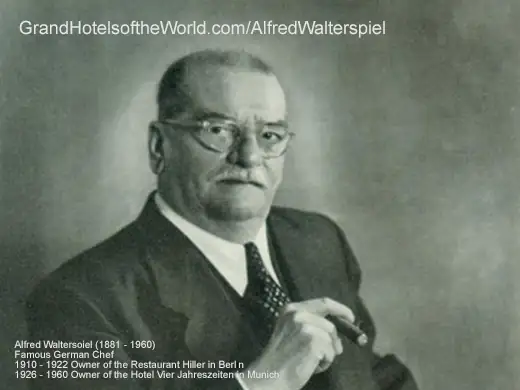
Chef, co-owner of the Vier Jahreszeiten from 1926. 1 hotel of the collection keeps track of him.
Few chefs have marked a grand hotel as deeply as Alfred Walterspiel. Trained on the Upper Rhine and polished in kitchens from Cannes to St Petersburg, he and his brother Otto made Munich’s Hotel Vier Jahreszeiten one of the most talked-about tables in Europe, and his name still stands for a refined, cosmopolitan school of German cooking.
Alfred Walterspiel was born on 11 May 1881 in Steinbach, a wine village near Baden-Baden, into a family of winegrowers. He learned the trades of confectioner and cook (in Strasbourg, according to the Neue Deutsche Biographie). Around 1900 he was working at the Erbprinz in Ettlingen, a renowned hotel-restaurant near Karlsruhe, the first step of a classic apprenticeship in the grand-hotel world.
Then came the wandering years that shaped every great chef of the Belle Époque. Walterspiel held responsible posts in leading houses in Baden-Baden, Cannes, Stockholm, St Petersburg and London before settling in Berlin as head chef of the Hotel Kaiserhof, whose company also ran the Hotel Atlantic in Hamburg. In 1909 he opened the Restaurant Pfordte at the Atlantic, and in 1910 he directed the German restaurant at the Brussels World Exhibition.
In 1910 Alfred and his brother Otto took over the Berlin gourmet restaurant Hiller from Lorenz Adlon, founder of the Hotel Adlon. Alfred ran the kitchen, Otto the business side. The First World War put an end to the venture: in 1917 the brothers closed Hiller, as luxury dining no longer suited a country at war, and Alfred spent the following years running a country estate near Berlin. In 1922 the brothers made a fresh start in Munich, opening the Restaurant Walterspiel on Fürstenstraße.
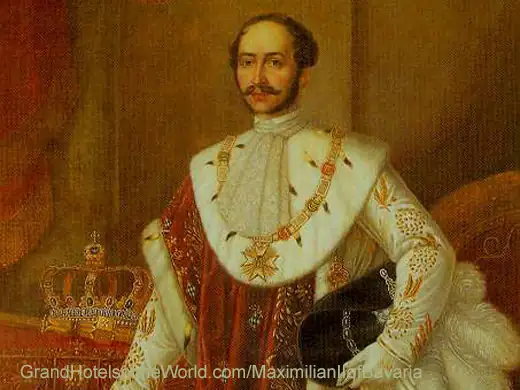
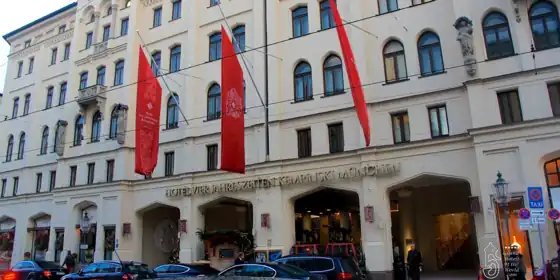
In 1926 the Walterspiels acquired from the city of Munich a majority stake in the company that owned the Hotel Vier Jahreszeiten, the grand hotel opened in 1858 on Maximilianstraße, the showpiece avenue of King Maximilian II. According to the Gustav Mahler Foundation’s history of the hotel, the house and its restaurant came to be regarded under the brothers as a first address in Europe, largely thanks to Alfred’s cooking. Otto’s son later recalled a childhood spent inside the hotel in his memoir, Ein offenes Haus.
The 1930s were less glittering than the menus. The Depression forced the company into insolvency proceedings in 1932, and its rescue, as the Neue Deutsche Biographie notes, enjoyed the backing of Hitler and Göring; in 1940 it became a limited company. Alfred was listed as an NSDAP candidate from 1943, and a 1948 tribunal classed him as a Mitläufer, a nominal follower. According to the German Wikipedia article on Alfred Walterspiel, the hotel remained open to international guests throughout the period.
Air raids in 1944 burned out every wing of the Vier Jahreszeiten except the one on Maximilianstraße, and American forces used the building after the war. Once the occupation authorities allowed the brothers to rebuild, the hotel came back to life at the end of the 1940s, with Alfred at its head until 1960; the Restaurant Walterspiel reopened in 1950. In 1952 he self-published Meine Kunst in Küche und Restaurant, a summing-up of his craft that went through many editions.
Alfred Walterspiel died in Munich on 8 May 1960, three days before his seventy-ninth birthday. His younger son Klaus joined the management in 1958, while his elder son Georg later taught business administration at the University of Munich, and the family kept the hotel until 1970, when it was sold to an investor group led by Kempinski.
The restaurant bearing his name long survived its founder. When Michelin published its first German guide in 1966, the Restaurant Walterspiel was among the 66 houses awarded a star, and Dieter Biesler cooked there through the 1970s. In 2014 the space was reborn as the Schwarzreiter, which held a Michelin star from 2018 to 2022, inside what is now the Hotel Vier Jahreszeiten Kempinski on Maximilianstraße.
Sources Wikipedia (DE), “Alfred Walterspiel” · Neue Deutsche Biographie 27 (2020), family article “Walterspiel” (Richard Winkler) · Gustav Mahler Foundation, “Hotel Vier Jahreszeiten (Munich)” · Wikipedia (EN), “Hotel Vier Jahreszeiten (Munich)”
1926: The brothers Alfred (1881-1960) and Otto (1884-1974) Walterspiel buy the hotel. Alfred is a famous cook, Otto a businessman. In 1910 they had acquired the Hiller Restaurant in Berlin from Lorenz Adlon (founder of the Hotel Adlon), which they turned into a succes, but after the end of the reign of the monarchy, their restaurant has no more clients. The Walterspiel moved to Munich where they opened the fashionable Walterspiel Restaurant (initially located on Fürstenstrasse). The city of Munich was content to find them as a buyer of the struggeling Hotel.
1927: The Walterspiel brothers renovate the Hotel and soon they were organizing one spectacular event after another, again the Hotel is in the public eye, a big success in the world of Palace Hotels. The Walterspiel brothers were living on the 5th floor of the north western backside of the Hotel. Aflred Walterspiel at the Hotel Vier Jahreszeiten in Munich.
Munich, Germany