Grand Hotel Amrâth
Amsterdam, Netherlands

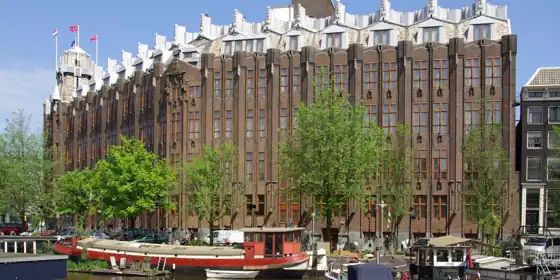
Amsterdam, Netherlands. Located on the Oudezijds Voorburgwal canal in the heart of Amsterdam’s old centre.
Photo
Author: bureau Monumenten & Archeologie (bMA)
Licence: Attribution
Image hosted by Wikimedia Commons, shown unaltered.
12 dates, written by Grand Hotels of the World from the sources below.
The site’s origins lie in the convent of St Cecilia, whose slender church turret still stands.
After the Alteration of Amsterdam, the convent is turned into lodgings for distinguished guests.
It becomes known as the Prinsenhof, possibly after a stay by William of Orange.
The Admiralty of Amsterdam takes over the building to house delegates and senior officials.
Marie de’ Medici, queen dowager of France, stays here; Princes Maurice and Frederick Henry of Orange were earlier guests.
After the old city hall on the Dam burns down, the Prinsenhof serves as temporary city hall until 1656.
The Admiralty rebuilds the complex from the ground up with a Palladian pilaster façade and a pediment featuring Neptune.
When Louis Napoleon takes the Dam city hall as his royal palace, the Prinsenhof becomes Amsterdam’s city hall.
An Amsterdam School extension by city architect Allard Remco Hulshoff is completed.
The council moves to the new Stopera on Waterlooplein, ending the building’s role as city hall.
The former city hall is restored and converted into a luxury hotel, The Grand.
After two years of renovation led by interior architect Sybille de Margerie, it becomes Europe’s first Sofitel Legend hotel.
Sources: Wikipedia (NL), “Prinsenhof (Amsterdam)” (CC BY-SA 4.0) · Official website · Official website – History · Hospitality Net, “Sofitel The Grand Amsterdam Becomes First Sofitel Legend in Europe” (1 July 2011). Text rewritten and translated by Grand Hotels of the World.
Amsterdam, Netherlands
Amsterdam, Netherlands
Amsterdam, Netherlands
Amsterdam, Netherlands


