Hotel Vier Jahreszeiten
Munich, Germany
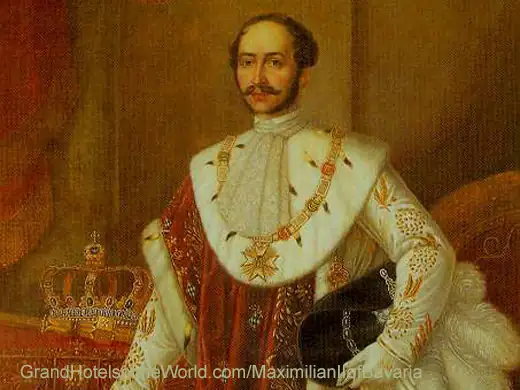
1811 – 1864
The king behind the Vier Jahreszeiten in Munich. 1 hotel of the collection keeps track of him.
Scholar-king of a Bavaria caught between revolution and German rivalries, Maximilian II left Munich a boulevard in his own image. On that avenue, the Maximilianstrasse, he wanted the finest hotel in the city, and the Vier Jahreszeiten was born of that wish.
Maximilian was born in Munich on 28 November 1811, the eldest son of King Ludwig I and Therese of Saxe-Hildburghausen. Unlike his flamboyant father, he was drawn to study: he attended the universities of Göttingen and Berlin, travelled through Germany, Italy and Greece, and joined the council of state in 1836. In 1832 he bought the ruined castle of Hohenschwangau, which he had restored in neo-Gothic style by 1837, and there he gathered artists and scholars around him.
In 1842 he married Marie of Prussia. Their two sons, Ludwig, born in 1845, and Otto, born in 1848, would both reign in turn, and both would end their lives declared insane. Beyond Hohenschwangau, his taste for Gothic Revival shaped his residences in Regensburg and Berchtesgaden, the villa on Rose Island and the redesign of Berg Castle, all expressions of a romantic, historicist vision of kingship.
He came to the throne on 20 March 1848, when Ludwig I abdicated amid the revolutionary unrest of that spring. His early ministers suggested a liberal course, but with Prussian help he crushed the uprising in the Palatinate in 1849, and from 1850 his government drifted towards a more authoritarian line. In German affairs he rejected the Frankfurt Parliament’s plans for unification and leaned towards Austria, whose failed reform proposal of 1863 left him disillusioned.
His true passion was learning. He invited to Munich scholars and writers such as the chemist Justus von Liebig, the historian Heinrich von Sybel and the poets Emanuel Geibel and Paul Heyse, regardless of their faith, to the irritation of Catholic conservatives. He funded studies of Bavarian costume, dialect and folk art, founded the Bavarian National Museum in 1855 and created in 1853 the Maximilian Order for Science and Art.
Architecture was his manifesto. From 1852 the architect Friedrich Bürklein laid out a perfectly straight avenue running south-east from Max-Joseph-Platz, by the Residenz, towards the Isar. Its buildings mixed English neo-Gothic and neo-Renaissance motifs in what became known as the Maximilian style, much criticised but unique in Munich. On the far bank rose Bürklein’s Maximilianeum, built from 1857 to 1874 as a foundation for gifted young Bavarians and today also the seat of the Bavarian parliament.
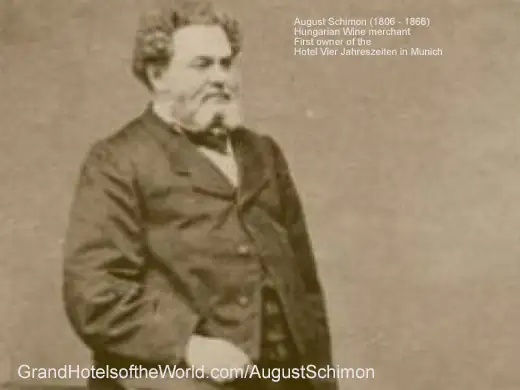
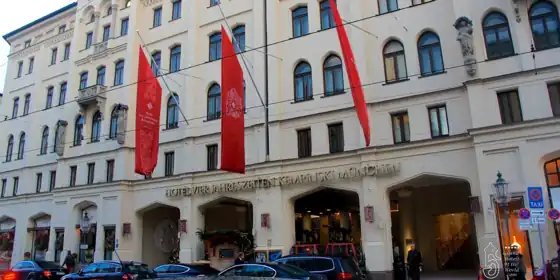
A royal avenue needed a worthy hotel. The king wanted the most elegant city hotel on his street, and on Bürklein’s recommendation the architect Rudolf Gottgetreu built it at number 17 between 1856 and 1858. The hotelier August Schimon opened the Vier Jahreszeiten on 25 July 1858. According to Kempinski’s history, Maximilian found the Residenz too small to lodge all his guests and called it the most beautiful hotel in the city. With gas lighting, bells in the rooms, six marble bathrooms and a paternoster lift, it was strikingly modern.
Often in poor health, Maximilian died in Munich on 10 March 1864, aged 52, after a short and unexpected illness, and was buried in the Theatinerkirche. His son Ludwig II, the builder of Neuschwanstein, succeeded him. The avenue he dreamed of survives as Munich’s most prestigious shopping street, and the Vier Jahreszeiten, which would host his cousin Empress Elisabeth, Franz Liszt and Richard Strauss among many others, remains the only hotel on Maximilianstrasse built at royal command.
Walking the avenue today is still a lesson in his reign. Beyond the hotel stand the government of Upper Bavaria, built by Bürklein from 1856 to 1864, and nearby Eduard Riedel’s building of 1858 to 1865, which first housed the National Museum and is now the Museum Five Continents. At the end, the Maximilianeum still serves the foundation for gifted young Bavarians that the king intended.
Sources Wikipedia (EN), “Maximilian II of Bavaria” · Wikipédia (FR), « Maximilien II de Bavière » · Wikipedia (DE), „Maximilianstraße (München)“ · Wikipedia (DE), „Hotel Vier Jahreszeiten (München)“ · Kempinski, “Munich: History in the Heart of Maximilianstrasse” · Kempinski, “Our hotel” – Hotel Vier Jahreszeiten · Wikipedia (EN), “Bavarian National Museum”
1848: Maximilian II (1811-1864) becomes King of Bavaria after the abdication of his father King Ludwig I of Bavaria (1786-1868). Maximilian II had the desire to create an elegant avenue in Munich near his Royal Residence. Made in the Neo Gothic style, measurig 23 m wide and 1,164 m long, the avenue is named after him, « Maximilian »strasse. The King was the father of King Louis II of Bavaria and an uncle of Sissi (Empress of Austria) and her sister Helene (Princess of Thurn & Taxis), they later return to the hotel.
Maximilian II had the desire to create an elegant avenue in Munich near his Royal Residence. Made in the Neo Gothic style, measurig 23 m wide and 1,164 m long, the avenue is named after him, « Maximilian »strasse. The King was the father of King Louis II of Bavaria and an uncle of Sissi (Empress of Austria) and her sister Helene (Princess of Thurn & Taxis), they later return to the hotel.
Munich, Germany